
Erie County Court Records After Arrest
After an Erie County jail arrest, the public record path splits. The sheriff's roster answers a narrow custody question: ICN, name, date of birth, facility, and booking date. The court record answers a different question: what charge was filed, where the case is pending, what release conditions were set, and whether the case ended in dismissal, plea, trial verdict, or another disposition. The formal case path runs through the New York Unified Court System, local court clerks, the Erie County Clerk when applicable, and the Erie County District Attorney's Office for state-law prosecutions.
The Erie County District Attorney's Office prosecutes most state-law crimes after arrest. Its official homepage identifies District Attorney Michael J. Keane as the chief law enforcement officer in the county, places the office at 25 Delaware Avenue in Buffalo, and says the office litigates about 25,000 cases per year in local, county, state, and specialty courts. A jail booking allegation may change after review. Prosecutors may file different charges, amend counts, reduce counts, present felony evidence to a grand jury, dismiss charges, or proceed by complaint, information, or indictment.
Custody and booking details belong with Erie County jail inmate records, while booking-photo questions belong with Erie County jail mugshots. Court records after an arrest are about the case that follows the booking.
Find Erie County Court Records
The first statewide case-search channel is New York WebCriminal. Use the defendant search when a name is known, and use the case identifier search when a case number or summons number is known. For Erie County arrests, likely court filters can include Buffalo City Court, Erie County Court, Erie County Supreme Court, Lackawanna City Court, Tonawanda City Court, and other local courts depending on the arresting agency and charge level.
- Confirm the recent custody context in the Erie County jail roster if the arrest is new.
- Open WebCriminal Defendant Search and search by first and last name.
- Narrow by court when the name is common or when the arrest came from a known city, town, or village court.
- Use WebCriminal Case Identifier Search instead when a case number or summons number is available.
- Compare each charge, status, and next date against clerk records because WebCriminal can show update delays.
The WebCriminal defendant search is the name-based court records after arrest channel.
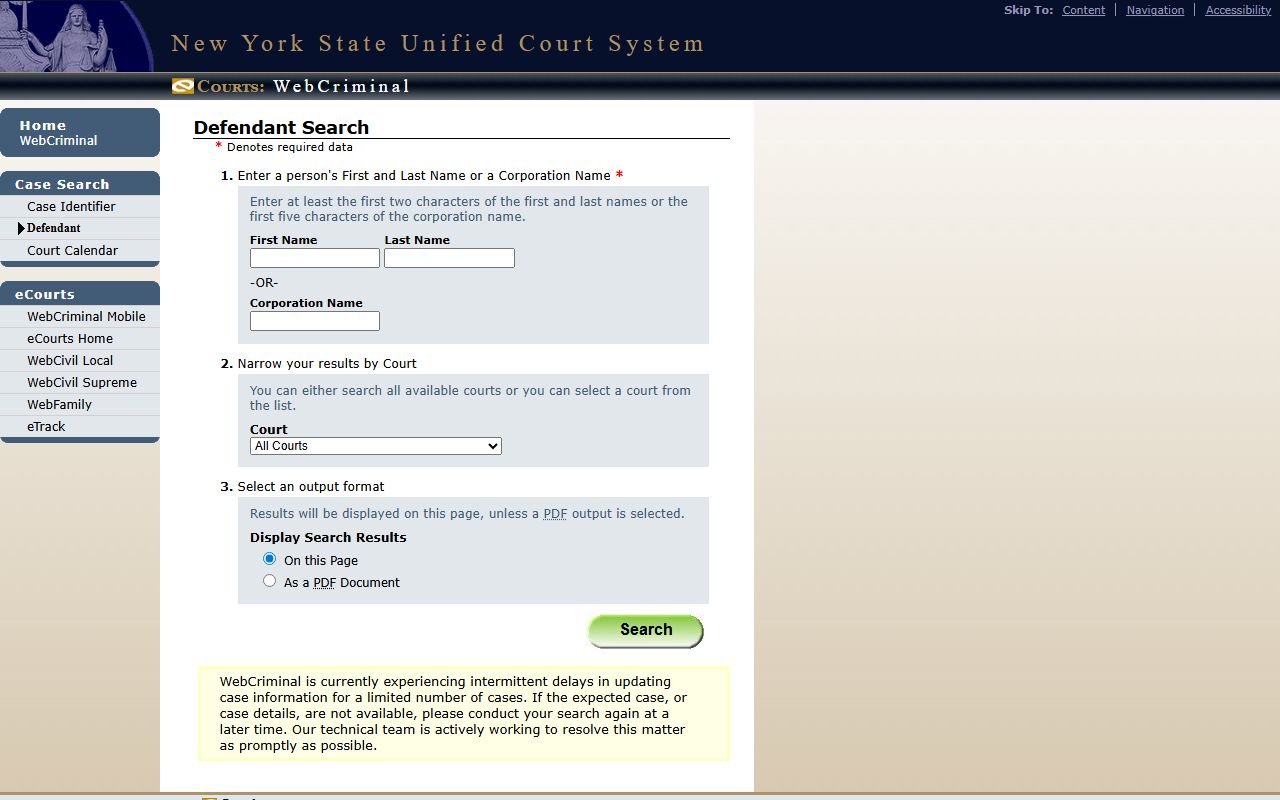
The defendant search is useful when the booking name is known but the case number has not been found yet.
Erie County Case Search Fields
WebCriminal provides two practical search paths. The defendant search starts with a person or corporation name. The case identifier search starts with a case or summons number. Both paths include court filters and output options, and both should be checked again later if a very recent arrest has not yet produced a visible court record.
| Portal | Field | Required | Notes |
|---|---|---|---|
| Defendant Search | First Name | Yes for person search | Enter at least the first two characters of first and last names. |
| Defendant Search | Last Name | Yes for person search | Use spelling from the jail roster if available. |
| Defendant Search | Corporation Name | Alternative | At least five characters for corporation searches. |
| Defendant Search | Court | No | Use Erie-related courts such as Buffalo City Court, Erie County Court, and Erie County Supreme Court. |
| Case Identifier | Case # | Alternative | Use when a clerk, attorney, notice, or docket entry gives the case number. |
| Case Identifier | Summons # | Alternative | Use when the matter began by summons rather than custody booking. |
| Both | Output format | Yes or default | Results may display on the page or as a PDF document. |
The WebCriminal case identifier search is the cleaner path when the case number is known.
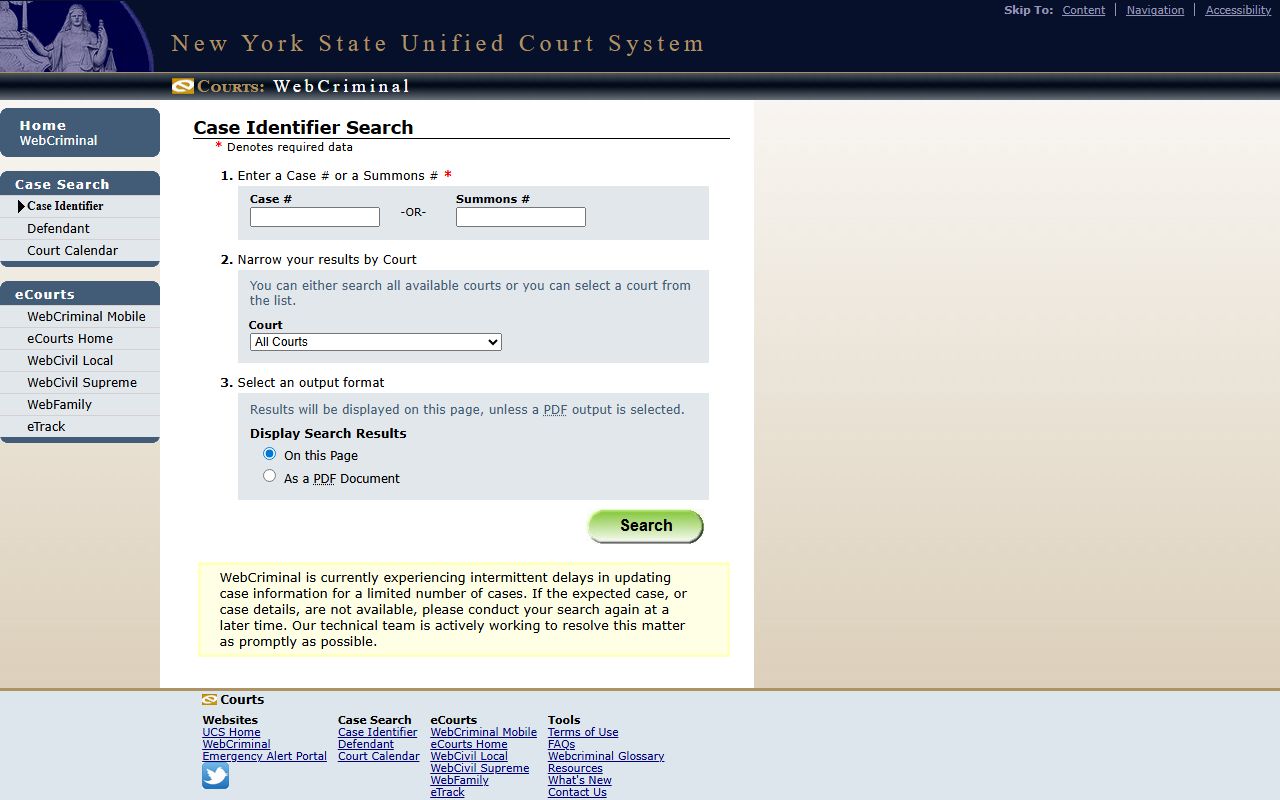
Case-number searching reduces false matches, especially when several Erie County defendants share a common name.
Erie County Arrest Charging Records
A court record after a jail arrest begins with an accusatory paper. The charging document is not the same as the roster line. It tells the court what offense is alleged and creates the case that judges, prosecutors, defense attorneys, and clerks track. The document type can depend on the charge level, stage of the case, and whether a grand jury has acted.
| Document | Who Uses It | What It Does | Common Context |
|---|---|---|---|
| Complaint | Police or prosecutor | Starts or supports a criminal accusation in court. | Often early case filing after arrest. |
| Information | Prosecutor | Charges an offense with sworn factual support. | Many misdemeanor or lower-court matters. |
| Indictment | Grand jury | Accuses a felony after grand jury presentation. | Serious felony prosecution in higher court. |
The Erie County District Attorney homepage identifies the office that handles these prosecution decisions.
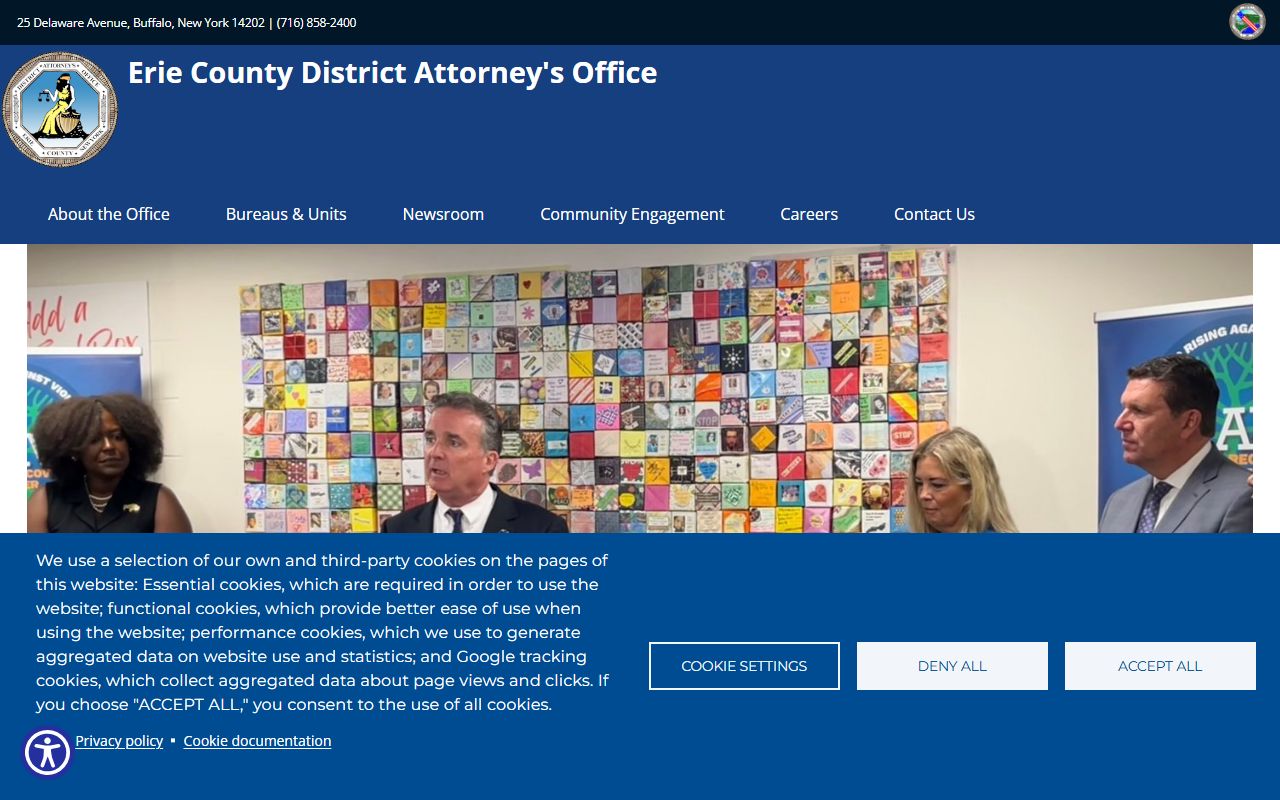
The DA's role explains why a booking allegation may not match the final court charges in WebCriminal or clerk records.
Erie County Clerk Records
Some Erie County court records after arrest are found through local clerk channels rather than only through WebCriminal. The Erie County Clerk court records page points users toward NYSCEF for e-filed case documents and explains that older or split record sets may require searching both online and clerk-held records. The New York Courts help page also directs people to request records from the Clerk of the Court or County Clerk that has the file.
The clerk route matters when a case has documents that are not displayed in the WebCriminal result, when the file is older, when the case moved to Supreme Court, or when the public needs copies rather than a docket summary. The Erie County Clerk notes that e-filed Erie County documents are available online for public viewing unless sealed by court order, but availability can depend on filing date and case type.
The Erie County Clerk court records page explains the split between NYSCEF and clerk-record access.
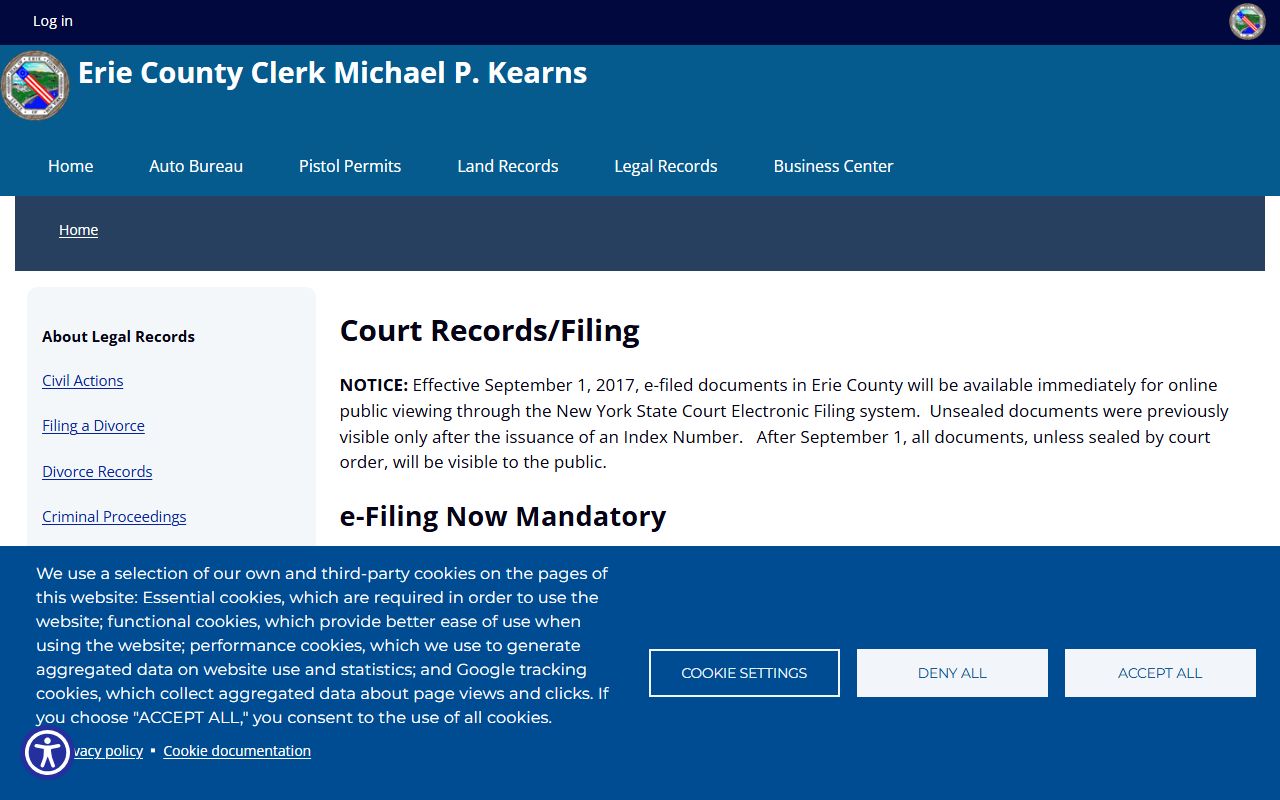
Use the clerk path when the search goal is a document copy, e-filed pleading, or older court file rather than a quick docket check.
Erie County Charge Status
Charges are not fixed at the moment of arrest. A case can start with one accusation and later show amended, reduced, added, dismissed, or indicted counts. A charge status should always be read as a case-stage marker, not as proof of guilt. The table below explains common status terms in plain language.
| Status | What It Means |
|---|---|
| Pending | The charge or case has not reached a final disposition. |
| Complaint or information | An accusatory instrument has initiated or charged the criminal case. |
| Indictment | A grand jury accusation supports felony prosecution. |
| Amended or reduced | The prosecutor or court changed the charge wording, count, or level. |
| Dismissed | The charge or case is not proceeding in that form. |
| Disposition | The final court outcome, such as dismissal, plea, verdict, or sentence. |
Erie County Bail and Warrants
Bail and release terms are court-driven. The sheriff takes custody and the sheriff FAQ says cash bails for city, town, and village courts are accepted 24 hours per day, seven days per week, but the court decides release on recognizance, non-monetary conditions, supervised release, cash bail, bond, remand, or another lawful condition. A person may remain in custody even when one case has bail if another hold exists, such as a bench warrant, parole issue, state-ready commitment, federal matter, or immigration detainer.
| Release Term | Plain Meaning |
|---|---|
| Release on recognizance | The court releases the person on a promise to return, with no money posted. |
| Non-monetary conditions | The court may order check-ins, supervision, travel rules, or other conditions. |
| Cash bail | Money is posted when the court authorizes cash bail for release. |
| Secured or partially secured bond | A court-set bond structure; local posting details should be verified before travel. |
| Remand or hold | The person remains held because bail is not set, not allowed, or another legal hold blocks release. |
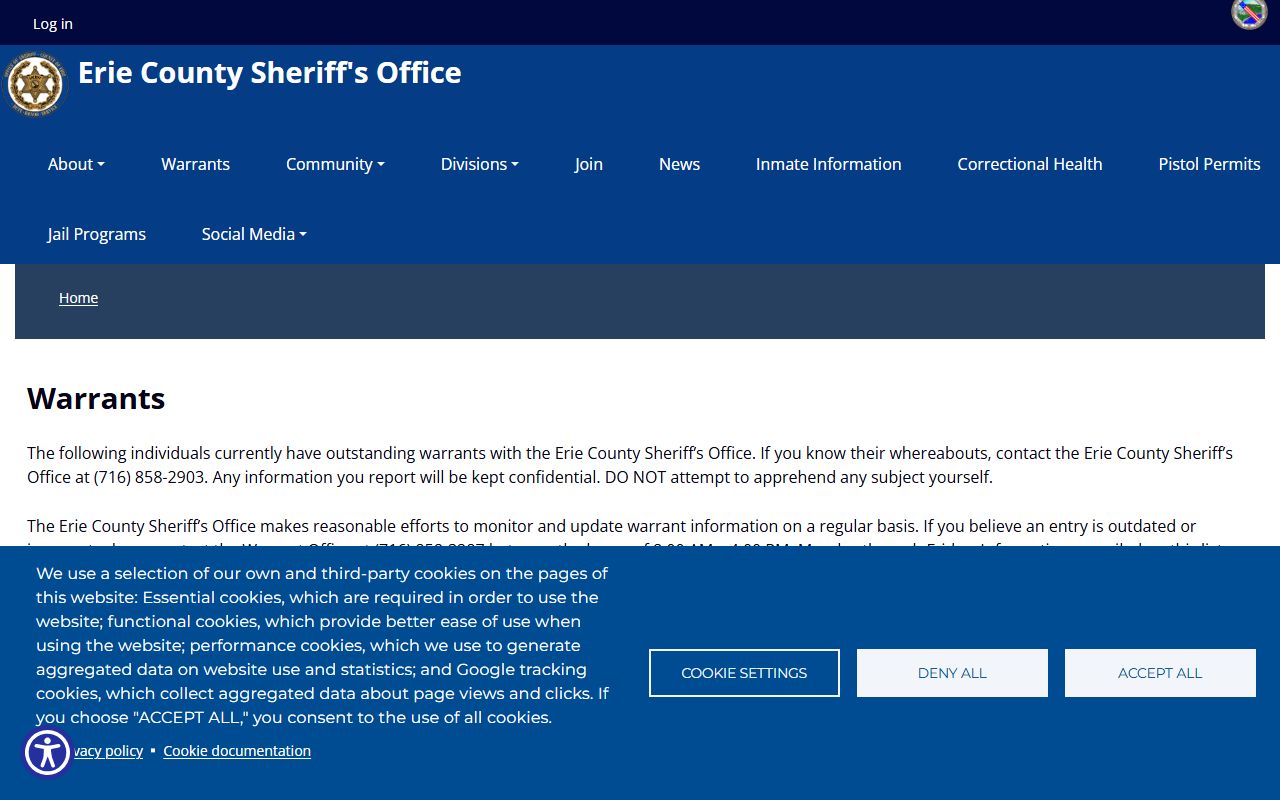
The Erie County Sheriff's Office, led by Sheriff John C. Garcia, also publishes an active warrants page. It lists wanted persons, includes a warning not to attempt apprehension, gives the confidential information line at (716) 858-2903, and gives the Warrant Office line at (716) 858-3287 for questions between 8:00 a.m. and 4:00 p.m., Monday through Friday.
The sheriff warrant list is relevant when a warrant led to the arrest or a bench warrant keeps a case active.
Warrant photos and wanted-person fields are not the same as court dispositions, so they should be checked against court records before being treated as case outcomes.
Erie County Charges and Convictions
An arrest and charge are accusations. A conviction is a finding or admission of guilt after plea or trial. Court records after an arrest can show both, but the distinction matters for employment, housing, licensing, and personal safety decisions. Public lookups often show an early charge before the final disposition is entered.
| Point | Charge | Conviction |
|---|---|---|
| Stage | Accusation after arrest or filing. | Final guilt finding or guilty plea. |
| Proof | Based on accusation and legal sufficiency at that stage. | Requires plea or proof beyond a reasonable doubt. |
| Can Change | May be amended, reduced, added, or dismissed. | May still be appealed, sealed, or affected by later court action. |
| Best Source | WebCriminal, clerk file, charging document. | Disposition entry, sentencing record, clerk-certified copy, CHRS where appropriate. |
For statewide court criminal-history searching, the New York OCA Criminal History Record Search is an exact name and date-of-birth search with a $95 fee. The DCJS record-review process is fingerprint-based and is the official state criminal history route for a subject's own RAP sheet.
Erie County Sealed Court Records
New York uses sealing rules that can restrict public access after certain favorable outcomes and protected adjudications. Criminal Procedure Law 160.50 covers sealing when a criminal action terminates in favor of the accused. Criminal Procedure Law 720.35 protects youthful offender records, which are confidential and are not judgments of conviction. Sealed or protected records may not appear in public court or DOCCS lookup systems.
| Point | Sealed | Expunged |
|---|---|---|
| Public Access | Restricted from ordinary public view by statute or court action. | Often used casually to mean erased, but New York relief is usually framed through sealing. |
| Law Enforcement | Limited access may remain for authorized agencies or legal purposes. | Do not assume a record is destroyed unless a specific court order or law says so. |
| Erie County Use | Apply through the case court or originating agency process when eligible. | Verify the exact remedy with the court file, not a private website or reposted copy. |
Important: A public court lookup is not an FCRA consumer report and should not be used for employment, tenant, credit, or insurance decisions.